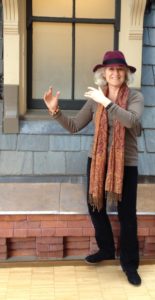
 Let me introduce myself: I’m a 60-year-old Canadian-American woman executing a very intentional life transition from full-time job to full-time writing. This is my first blog post about it. My intention is to focus the blog on my progress into a new daily creative life, in the hopes that you will find it helpful in navigating a similar transition, and as a way for me to understand my own journey.
By full-time writing I mean primarily focused on writing (after all you can’t write 24/7, and if you tried, you’d be a bore: what would there be to write about?). For instance, I am also a flutist (this photo is me playing air flute last year at my alma mater, the Royal Conservatory of Music in Toronto). As well as flute, I play recorders, a little piano, and guitar, and I sing. I love seriously long walks, yoga, dinner parties with friends, playing music with my family, talking into the night with my son, concerts, travel, the ocean (this list sounds a bit like a dating ad–note: I have a lovely husband on this journey with me). I like to spend time with my rollicking, wonderful family. I love dogs, though sadly I do not have a dog in my home right now. I stay on the lookout for people willing to share their dogs with me.
I started writing stories, poems, and songs early in life, and throughout the past four decades, I have gone in and out of a professional relationship with those pastimes. I’ve published, I’ve done readings, and I’ve performed. Mostly, though, I’ve worked for arts/youth nonprofits and environmental consultants, as a leader, staff writer, and administrator. I’ve known though, all along, that “full-time writer,” (and I mean so-called “literary writer”) is my true calling.
My nonprofit career has been rich–I’ve travelled widely and met wonderful people who are now lifelong friends, and I’m proud of the work I’ve accomplished–yet full-time creative writing is what I’ve been dreaming about since I was in elementary school. It’s been my central purpose and identity and my focus in my education, which includes an MFA in Creative Writing and what I like to call a PhD in Delayed Gratification.
I couldn’t–didn’t–make writing my full-time work.
I think delayed gratification is not that unusual, especially for women. Doing what is asked or expected of us, doing what seems safe or reasonable, feeling the need to pay the bills, raise children, take care of parents, give to your community, clean the house, walk the dog… all of that’s not made up.
But once you take jobs, as I have, that are almost what you want to do, or because it’s a means to something rather than doing the thing itself, you are on dangerous ground.
Over the years, I’ve told myriad young people to follow their heart in their work, to find their life’s essential purpose and then pursue it like hell. I’ve told them that whatever specific work they choose will make them into a magnet that attracts more of that specific work. If you become a dogwalker as a profession, for instance, then dogs will just come flying at you. Your life will be all about park-walks and jerky-treats and dog-beds (aah, sounds good). But kidding aside, you need to think about whether dogwalking is really it for you.
I haven’t taken this advice myself, though.
Writing that dog-walking sentence above is an example: I can seriously imagine being a dog-walker. I mean, I love dogs. I’ve never been able to choose between writing and music, so I try to do both. I’ve written umpteen things for other people or organizations. I’ve drilled down into all kinds of wonderful projects and activities and organizations–arts, youth, environment–but left my own writing, my creative writing, to the weekends or the wee hours. I love too many things. I know I need to say “no” more often. And I’ve worried about my bills. Always, the damn bills.
I made an earlier failed attempt to get focused in 2002. After quitting my job, I found the economic pressure so worrying that instead of staying focused on my writing, I grew a music teaching studio that included 35 (dearly-loved) private students a week and I taught myriad music classes at six different schools. Then came two major family crises–a family member in jail who needed my help, and my own divorce–all of this put the kabosh on my attempt to reach a different life.
I am hardwired to respond to bill-collectors and family and cool projects. And I admit, I like the dishes to get washed each night. I am guilty of delaying what I love both for very important things like family, and for trivialities.
After my divorce, I worked another ten years in a beautiful community, at a deeply worthy job, with and for people I love. But I couldn’t shake the feeling–didn’t want to shake the feeling–that it was still not the ultimate reason I was put on this planet.
I’ve waited, then, until I am entirely free and able to take this step. My son is independent, the nonprofit I was leading is stable, my husband is on track timewise and spiritwise with me (I remarried after my divorce), and we have some financial resources (something I really never thought I would experience in this lifetime). All my ducks in a row.
Was this right for me? Doesn’t matter now! But it sure is unlike the advice I’ve given to young people all these years. And now, since I am no longer young, what advice do I give myself? Perhaps I should take to heart the words I’ve offered my middle-aged friends over the years. That is, when someone regrets that they never learned to play the ____ (fill in the blank with name of musical instrument), I tell them they should do it, now, no matter what age they are. My rhetoric is: “You’re going to become five years older than you are now, no matter what. Why not arrive there knowing how to play the guitar?”
So, in five years I will be 65 no matter what, and why not arrive there having written a book?
In the spirit of sharing with you, kind reader, how I am finally taking my own advice, here are the steps I took / am taking, at 60, to pursue my life’s purpose. Including these here makes this blog post longer than what is recommended, but I risk going long in the hope that these steps will be of help to you.
First step is to figure out how you will leave your job. You just can’t have a demanding job that fills your brain and much of your spare time, and also write seriously. Unless you want to write half-ass stuff. Or do your job half-ass.
My husband Dave and I left our jobs last May/June after years of discussion and decision-making (that was crucial for us, as there were others depending on us in various ways).
Leaving a career and a beloved community can be hard. Transitioning out of my Executive Director job at Caldera in Portland, Oregon was both the most intentional and the most emotional career transition I have ever made (on par only with the first, aforementioned failed attempt I’d made to clear my life for writing, when I left the Alliance of Artists Communities.). Both are crazy wonderful creative communities. When I left them, I wanted to leave them in good shape, to execute a positive leadership transition. That takes time and care.
Second step is to plan your finances so that you don’t fail in your getaway attempt (the way I did with my first try). Find someone who will work with you to make it happen. My husband Dave was and is incredibly helpful in this regard, drafting financial plans and schedules. These help me deal with my working-class, long-time fear of being destitute (which is a fear, I have found, that never leaves me, even when we are far from destitute.) And also keeps me from spending as if I won’t live out the next decade. We downsized our house and our budget.
Third step is to find those people in your life who will cheer you on, and to state your intentions publicly and clearly. Go back to your mentors from years ago, find new mentors, and ask family members and friends to support you. Ditch naysayers, and correct well-meaning friends and colleagues. You don’t have to go along with other people’s interpretation of your past or public self. Many a person was corrected by me when they congratulated me on retiring or made cracks about how I would be drinking mai-tais into the future — no, I was transitioning to full-time, self-employed writing, not becoming a drunk or taking up golf (nothing against golf, of course).
Fourth step for me was to visualize how, and in our case where, we would live. We wanted to change our living situation. We bought a house in Canada (note: there’s no need to buy a house in a different country to write full-time!) because I yearned for “home” and Dave yearned for the Atlantic. We’ve figured out how, for awhile at least, we can live part of the year in Oregon, and part of the year in Nova Scotia.
And we wanted to travel. After leaving our jobs, Dave and I took three weeks to drive across the continent in a car (from Portland, Oregon, USA, to Lunenburg, Nova Scotia, Canada) loaded mostly with Dave’s CDs (truly, 3,500 of them), and a few other things squished in (some clothes, my flute, our computers).
Fifth step is to get organized. I know it will take several more years for me to really occupy the “full-time writer” role. Here are some sub-steps to this part, that I have taken to support my writing, and to make my transition obvious, to me and to the world:
- I started this blog (which my fingers continually type as “glob” or “glog”–I hope my posts are better shaped than globs, and I hope to drink a little glog along the way!)
- I posted one photo and one paragraph a day during our trip across the continent. Doing so was like a pregnancy… in that I had our unhurried drive across the continent to contemplate what it means to me to live in Canada again, to slow down after a very busy and stressful job, and to let my writer-mind come back to the fore. Some of those Facebook posts will make up my next blog post.
- I launched a web site: TriciaSnell.com. I am very grateful to Fara Heath and Susan Langenes of Collage Creative for their website-creation magic, and their emails and conference calls as we created it during my journey across the continent.
It feels like I am stepping into a long-dreamed-of circus tent. Despite the public aspect of my career, I am a rather private person; public humiliation is not my thing. But, nothing ventured, nothing gained, as my mother used to say (though maybe it was Chaucer who came up with that).
Next obvious sub-steps to getting organized, and then really launched, are:
- Send out more of my stories, essays, and poems to magazines and journals. I have drawers full, after years of weekend writing without sending.
- Complete some unfinished work (including an unfinished novel that requires either scrapping or reusing).
- Begin new work and plan two book-length manuscripts I’ve been imagining for awhile.
- Focus. Bring the same level of energy I poured into my jobs, into my own work.
- Continually recognize how fortunate I am to be able to do this, and express that gratitude.
I’ll begin by thanking you. I hope you’ll continue along with me in this blog. I’d love to hear in the comments below about your transitions, and I’d love it if you subscribed to this blog. I promise that as I proceed into the circus tent, I’ll be as real… and as naked … as I can be…
With love,
Tricia
Recent Comments